Your Gut Is Running the Weight Loss Show: The Microbiome Connection
Your Gut Is Running the Weight Loss Show
What your microbiome is really doing (and how to work with it, not against it)
If you've ever felt like you're doing everything "right," eating less, moving more, reading every label, and still not seeing the results you deserve, I want you to hear this: it is not a willpower problem. It is not a discipline problem. And it is almost certainly not as simple as calories in versus calories out.
The missing piece for so many of my clients is something most conventional health advice never mentions: the 39 trillion microorganisms living in your gut. Your microbiome (the vast ecosystem of bacteria, fungi, and other microbes in your digestive tract) is one of the most powerful regulators of your metabolism, your hunger, your energy, and your body composition. And when it's out of balance, no diet in the world is going to feel easy.
What Your Gut Bacteria Actually Do
Think of your microbiome as a second brain for your metabolism. These microbes aren't just helping you digest food, they're actively communicating with your immune system, your hormones, and even your brain via the gut-brain axis (a direct communication highway that runs through your vagus nerve).
Here's what's happening beneath the surface:
They control how many calories you absorb. Two people can eat the exact same meal and absorb a different number of calories from it, depending on the makeup of their gut bacteria. Certain bacterial strains are extremely efficient at extracting energy from food. If those strains dominate your gut, you may be getting significantly more calories from the same portions as someone else.
They regulate your hunger hormones. Beneficial bacteria produce short-chain fatty acids (SCFAs) like butyrate, propionate, and acetate when they ferment fiber. These SCFAs stimulate the release of GLP-1 and PYY, hormones that signal fullness to your brain. When these bacteria are depleted, those satiety signals weaken. You finish a meal and feel unsatisfied even when you've eaten enough. Sound familiar?
They drive inflammation. An imbalanced microbiome (known as dysbiosis) can compromise the gut lining, allowing bacterial byproducts called lipopolysaccharides (LPS) to leak into the bloodstream. This triggers a low-grade, chronic inflammatory response throughout the body. That inflammation directly contributes to insulin resistance, elevated cortisol, and the stubborn fat storage that tends to accumulate around the midsection.
They affect blood sugar stability. A diverse, healthy microbiome helps slow glucose absorption and improves insulin sensitivity. When the microbiome is disrupted, blood sugar swings become more dramatic, leading to energy crashes, brain fog, and intense cravings for sugar and refined carbs. It's a cycle that can feel impossible to break from the outside.
What Disrupts the Microbiome
Before we talk about what helps, it's worth acknowledging what hurts, because many of us are unknowingly working against our gut every day.
Ultra-processed foods are among the biggest offenders. Emulsifiers (like carboxymethylcellulose and polysorbate-80, found in many packaged foods) have been shown in research to directly alter the gut microbiome, reduce microbial diversity, and degrade the intestinal mucus layer. Artificial sweeteners, even though they have no calories, can shift gut bacteria in ways that impair glucose metabolism.
Antibiotic use, chronic stress, poor sleep, and even a lack of time outdoors in nature all deplete microbial diversity. The Western lifestyle, in many ways, is not kind to our gut bugs.
How to Rebuild and Nourish Your Microbiome
Here is the genuinely good news: your microbiome is highly adaptable. Studies show measurable shifts in microbial composition within just 48 to 72 hours of changing what you eat. You are not stuck. Here's where I focus with my clients:
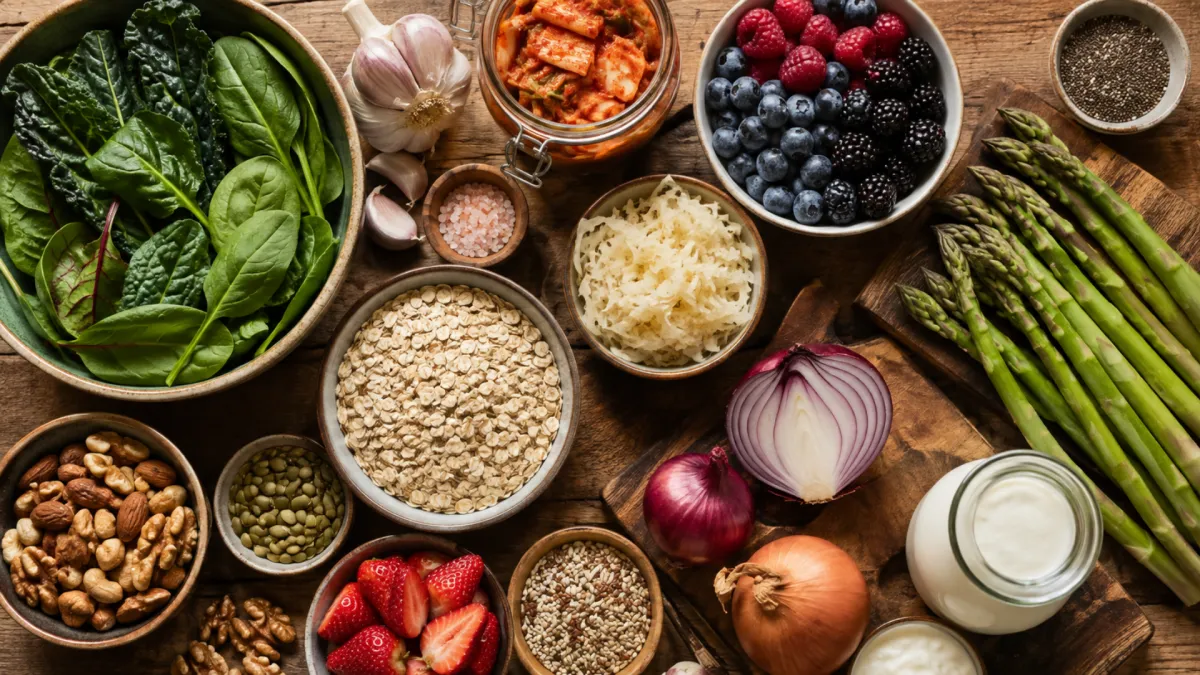
Aim for 30 different plants per week. Research from the American Gut Project found that people eating 30 or more different plant foods weekly had significantly more diverse microbiomes than those eating 10 or fewer. This includes vegetables, fruits, legumes, whole grains, nuts, seeds, herbs, and spices. Variety is the key word here, not quantity.
Add fermented foods daily. A 2021 Stanford study found that a diet high in fermented foods (yogurt, kefir, kimchi, sauerkraut, kombucha, miso, tempeh) increased microbiome diversity and reduced inflammatory markers more effectively than a high-fiber diet alone. Even small amounts daily matter.
Feed your gut with prebiotic fiber. Probiotics get most of the attention, but prebiotics (the fiber that feeds beneficial bacteria) are equally important. Great sources include garlic, onions, leeks, asparagus, green bananas, oats, and Jerusalem artichokes. Think of prebiotics as fertilizer for your gut garden.
Protect your sleep and manage stress. Cortisol directly alters gut bacteria composition, reduces microbial diversity, and increases intestinal permeability. Poor sleep has similar effects. I know these are easier said than done, but even small improvements in sleep quality and stress management can have a meaningful impact on your gut and, in turn, your weight.
Be thoughtful about what you reduce. Cutting back on ultra-processed foods, alcohol, and added sugars gives your beneficial bacteria room to flourish. You don't have to be perfect, but even a meaningful reduction makes a difference.
My Take
Sustainable weight loss isn't about white knuckling through another restrictive diet. It's about building internal conditions where your body actually wants to find balance. A healthy microbiome lowers inflammation, stabilizes hunger, improves insulin sensitivity, and makes healthy eating feel far less like a battle.
When we work on gut health, we're not just improving digestion, we're shifting the entire metabolic environment. That's why I approach weight loss from the inside out, not the outside in.
If this resonates with you, or you've been struggling with weight despite doing "all the right things," I'd love to dig into what's happening for you specifically. Reach out, I'm here.
To your health,
Cathy Jordan
Vital-Balance Health
[email protected]
